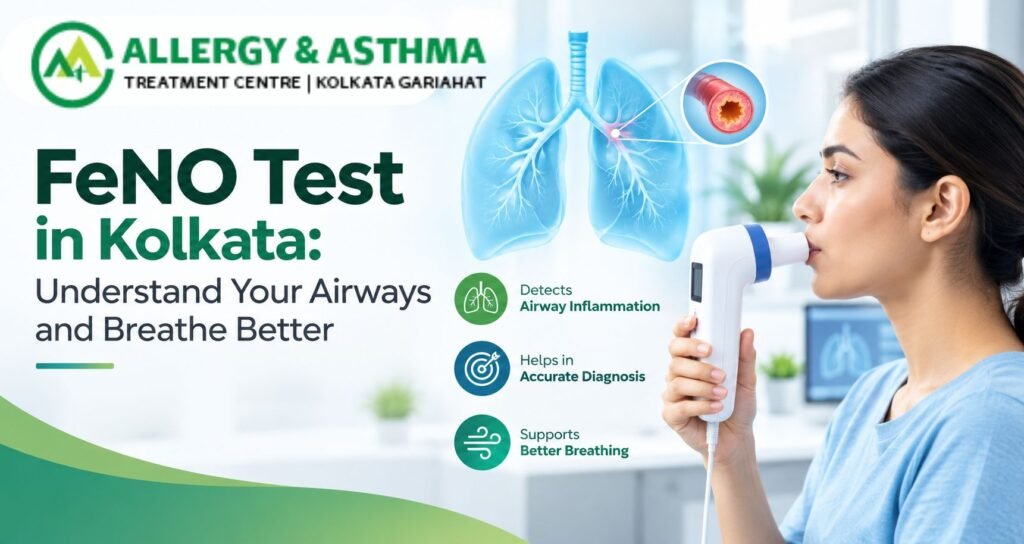
Breathing problems can be frustrating, particularly when coughing, wheezing, chest tightness, or shortness of breath keeps returning. While these symptoms may occur with asthma, understanding what is happening inside your airways can help your doctor choose an appropriate approach. A FeNO test in Kolkata offers a simple, non-invasive way to measure a specific marker associated with airway inflammation.
At Allergy & Asthma Treatment Centre, respiratory assessment focuses on understanding symptoms, possible triggers, and underlying inflammation. If you have asthma, allergies, or unexplained breathing difficulties, FeNO testing may provide useful additional information about your respiratory health.
What Is a FeNO Test?
FeNO stands for Fractional Exhaled Nitric Oxide. Nitric oxide is naturally produced in the body and can be detected in the air you breathe out.
Increased levels of nitric oxide can be associated with eosinophilic or Type 2 inflammation in the airways, a pattern commonly found in certain people with asthma.
A FeNO test measures the concentration of nitric oxide in exhaled breath. Results are usually expressed in parts per billion, or ppb.
Unlike blood tests, FeNO testing does not involve needles. There is also no radiation or complicated procedure, making it a convenient investigation when clinically appropriate.
Why Is FeNO Testing Important for Asthma?
Asthma does not behave identically in everyone. Two patients may experience similar wheezing, coughing, or breathlessness while having different patterns of airway inflammation.
This is why symptoms alone do not always provide the complete picture.
A doctor may use FeNO testing to identify evidence associated with eosinophilic airway inflammation and assess whether corticosteroid-responsive inflammation may be present.
However, FeNO is not generally used as a standalone test to diagnose asthma. Results are considered alongside your symptoms, medical history, physical examination, lung-function tests, allergy evaluation, and other appropriate investigations.
Who May Need a FeNO Test in Kolkata?
Your doctor may recommend a FeNO test in Kolkata when additional information about your airways could help with respiratory assessment.
You may be considered for testing if you experience persistent coughing, recurring wheezing, shortness of breath, chest tightness, suspected allergic asthma, or symptoms that remain difficult to explain.
FeNO testing may also be considered for some people who already have asthma when doctors need more information about airway inflammation or changes over time.
Whether you need the test ultimately depends on your symptoms, medical history, current treatment, and doctor’s clinical assessment.
How Is a FeNO Test Performed?
The procedure is straightforward and generally takes only a short time.
You will breathe through a mouthpiece connected to a specialised FeNO analyser. After breathing in as instructed, you will slowly and steadily breathe out into the device.
Maintaining the correct airflow during exhalation is important for obtaining a reliable measurement. A healthcare professional will guide you through the technique.
The analyser then calculates the nitric oxide concentration in your breath and provides a numerical result.
Because the procedure simply analyses exhaled air, it is painless and non-invasive.
How Should You Prepare for FeNO Testing?
Preparation can influence the accuracy and interpretation of your result.
Before your appointment, tell your healthcare provider about your medications, inhalers, allergies, recent infections, smoking status, and relevant medical conditions.
You may receive instructions about eating, drinking, smoking, or exercising before testing because certain activities can affect FeNO measurements.
Most importantly, do not stop using prescribed inhalers or asthma medicines unless your doctor specifically asks you to do so. Anti-inflammatory medication may influence FeNO levels, but treatment changes should always be medically supervised.
What Do FeNO Test Results Mean?
FeNO results are generally measured in parts per billion (ppb).
For adults, established clinical guidance commonly interprets results broadly as:
Below 25 ppb: eosinophilic airway inflammation is generally less likely.
25–50 ppb: an intermediate measurement that requires careful interpretation within the patient’s clinical situation.
Above 50 ppb: eosinophilic airway inflammation and corticosteroid responsiveness may be more likely.
Different thresholds are used when evaluating children.
A higher result does not automatically mean you have asthma, and a lower result does not automatically exclude it.
Age, allergies, smoking, medication, allergen exposure, respiratory conditions, and other factors may affect results. Your doctor should therefore interpret the measurement alongside your overall clinical picture.
FeNO Test vs Spirometry: What Is the Difference?
FeNO testing and spirometry provide different types of information.
Spirometry measures lung function, including how much air you can breathe out and how effectively air moves through your lungs.
FeNO testing measures nitric oxide in exhaled breath, providing information associated with a particular type of airway inflammation.
For selected patients, using these investigations together can help doctors understand both lung function and inflammation rather than relying on symptoms alone.
Can FeNO Help Monitor Asthma?
FeNO testing can sometimes be useful after asthma has already been diagnosed.
Repeated measurements may help clinicians observe changes in airway inflammation over time. These trends can be considered alongside symptoms, inhaler use, lung-function results, possible allergen exposure, and treatment response.
However, patients should never change asthma medication based solely on a FeNO number. Treatment decisions require professional clinical assessment.
Benefits of FeNO Testing
One important advantage of FeNO testing is simplicity. The test is quick, needle-free, radiation-free, non-invasive, and generally easy to perform.
It also provides measurable information about airway inflammation that cannot always be understood from symptoms alone.
For patients, this can make asthma assessment easier to understand. For doctors, FeNO can provide another useful piece of the respiratory-health puzzle.
Is a FeNO Test Safe?
FeNO testing is generally considered safe because it simply measures nitric oxide while you breathe out.
There are no injections or exposure to radiation. Adults and many children who can follow the required breathing instructions may be able to complete the test successfully.
Your healthcare provider can determine whether it is suitable for you.
Why Choose Allergy & Asthma Treatment Centre?
Managing recurring respiratory symptoms starts with understanding what may be causing them.
At Allergy & Asthma Treatment Centre, patients can receive assessment for asthma, allergies, and respiratory concerns. Clinical evaluation may combine symptoms, medical history, lung-function assessment, allergy information, and appropriate tests to create a more complete picture.
If you are searching for a FeNO test in Kolkata, consultation with a respiratory specialist can help determine whether the test is appropriate for your condition.
FAQs:
What does a FeNO test detect?
A FeNO test measures nitric oxide in exhaled breath. Increased levels can be associated with eosinophilic or Type 2 airway inflammation.
Can FeNO diagnose asthma?
FeNO can support asthma assessment but should not generally be used alone to diagnose asthma. Doctors consider the result alongside symptoms, medical history, lung-function testing, and other findings.
What is a normal FeNO level?
For adults, values below 25 ppb are generally considered relatively low, 25–50 ppb intermediate, and above 50 ppb high. Different thresholds apply to children, and results require clinical interpretation.
Is FeNO testing painful?
No. FeNO testing is non-invasive and needle-free. You simply breathe into a specialised analyser according to the instructions provided.
How long does a FeNO test take?
The measurement itself is generally quick. Appointment duration can vary if consultation, spirometry, allergy testing, or other assessments are also required.
Where can I get a FeNO test in Kolkata?
People looking for a FeNO test in Kolkata can contact Allergy & Asthma Treatment Centre to discuss their symptoms and determine whether FeNO testing is appropriate.
Take a Step Towards Better Breathing
Persistent coughing, wheezing, breathlessness, or chest tightness deserves proper evaluation rather than guesswork.
FeNO testing can provide valuable additional information about certain types of airway inflammation and help doctors develop a clearer understanding of respiratory symptoms.
If asthma or recurring breathing difficulties are affecting your daily life, consider consulting Allergy & Asthma Treatment Centre about whether FeNO testing should be part of your respiratory assessment.
Understand your airways. Breathe with confidence. Believe in better respiratory health.
Read More: