Itchy skin, recurring rashes, redness, or swelling can make everyday life uncomfortable. Sometimes the trigger is obvious; often, it is not. A skin allergy test can help a qualified clinician investigate whether an allergic reaction may be responsible and identify possible triggers.
What Is a Skin Allergy Test?
A skin allergy test checks how your body reacts to selected allergens or substances. Depending on your symptoms, a clinician may recommend a skin-prick test, an intradermal test, or patch testing. No single test detects every allergy, and results must be interpreted alongside your medical history and examination.
Tests may investigate reactions to pollen, dust mites, mould, animal dander, or contact allergens. The right test depends on how quickly symptoms develop.
Which Types of Skin Allergy Tests Are Available?
1. Skin-Prick Test
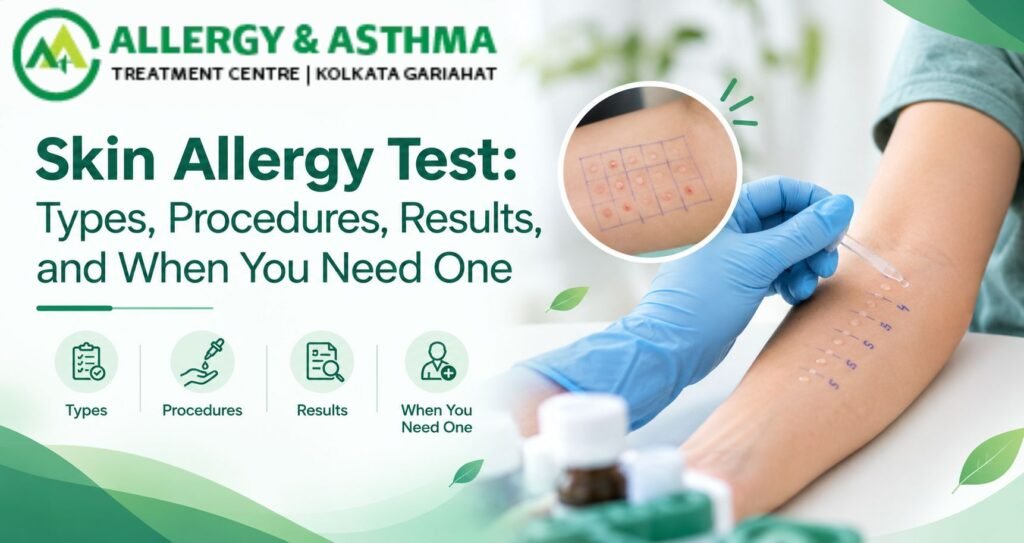
During a skin-prick test, small drops of selected allergens are placed on the skin, commonly on the forearm or back. The surface is gently pricked so a tiny amount can enter the outer layer. A clinician checks for a raised, itchy bump after a short waiting period, usually around 15–20 minutes.
This test can help assess immediate allergies, including some environmental allergens and selected foods. A positive result shows sensitisation, but does not automatically prove that the substance causes symptoms.
2. Intradermal Test
An intradermal test introduces a very small amount of allergen into the skin. It may be considered for specific clinical questions, such as selected insect-venom or medicine allergies. It is not suitable for every allergy and must be performed by trained professionals in an appropriate setting.
3. Patch Test
Patch testing is mainly used to investigate allergic contact dermatitis, a delayed reaction that may follow contact with substances such as nickel, fragrances, preservatives, rubber, or hair-dye ingredients. Small amounts of suspected contact allergens are placed on patches and attached to the skin, often on the back. Patches usually remain in place for about 48 hours, followed by scheduled readings.
What Is a Type 4 Skin Allergy?
A type IV allergy, also called a delayed-type hypersensitivity reaction, is driven mainly by immune cells called T lymphocytes rather than by IgE antibodies. Symptoms often appear 24–72 hours after contact, although timing varies. Allergic contact dermatitis from nickel, fragrances, or certain cosmetic ingredients is a common example.
Patch testing is commonly used when a clinician suspects this kind of reaction. A type IV allergy is different from an immediate allergy that may cause rapid hives, swelling, wheezing, or other symptoms.
Can CBC Detect Skin Allergy?
A complete blood count (CBC) cannot diagnose a skin allergy by itself. It measures blood components, including red cells, white cells, and platelets. The differential count may show eosinophils, a type of white blood cell that can be elevated in some allergic conditions. However, eosinophils can also rise for other reasons, and many people with allergies have normal CBC results.
A CBC may help a clinician assess the wider picture, but it does not identify the specific allergen causing a rash. Depending on symptoms, the clinician may recommend skin testing, specific IgE blood tests, patch testing, or another evaluation.
What Is a Normal Total IgE Level?
Immunoglobulin E (IgE) is an antibody involved in many immediate allergic reactions. A total IgE blood test measures the overall amount of IgE in the blood, not the response to one specific allergen.
There is no single normal total IgE range that applies to every person and laboratory. Reference ranges vary with age, testing method, and the laboratory used; children may have different ranges from adults. A raised total IgE level can occur with allergies but may also be associated with other conditions. Conversely, a normal total IgE level does not rule out an allergy.
Specific IgE tests measure responses to particular allergens. Ask your clinician to explain your report in relation to your symptoms.
How Should You Prepare for a Skin Allergy Test?
Tell the clinician about your symptoms, when they occur, suspected triggers, existing conditions, and all medicines or supplements you take. Some antihistamines can affect skin-prick test results, so the clinic may advise whether and when to pause them. Do not stop prescribed medicines without instructions. Avoid applying creams to the test area unless the clinic says otherwise, and follow its preparation guidance.
When Should You Seek an Allergy Evaluation?
Consider an assessment if you experience recurring itchy rashes, hives, swelling, eczema that worsens after contact with products, or symptoms that repeatedly follow exposure to a suspected trigger. Seek urgent medical help if a reaction causes breathing difficulty, throat or tongue swelling, faintness, or rapidly worsening symptoms.
FAQs:
Is a skin allergy test painful?
Skin-prick testing usually causes brief discomfort rather than significant pain. Patch testing is generally painless, although the skin may become itchy or irritated.
Does a positive test mean I definitely have an allergy?
Not necessarily. A positive result may indicate sensitisation. It must match your symptoms and exposure history to be clinically meaningful.
Which test is best for skin allergies?
The best test depends on the suspected reaction. Skin-prick testing may help assess immediate allergies, while patch testing is commonly used for delayed contact allergy.
Take the Next Step Towards Understanding Your Allergy
Persistent skin symptoms deserve a careful assessment rather than guesswork or repeated self-treatment. Contact Allergy & Asthma Treatment Centre to discuss your symptoms and whether a skin allergy test or another investigation may be appropriate.
This article is for educational purposes only and does not replace medical advice, diagnosis, or emergency care.
Discuss test options with your clinician.
Read More: