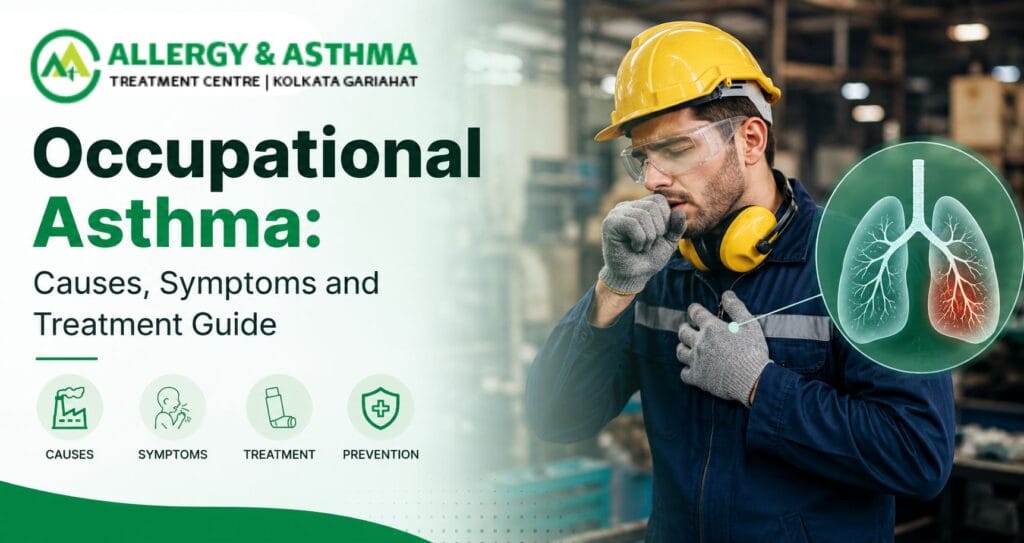
The workplace gave him asthma, and it took two years to figure that out.
He’d been managing with inhalers for eighteen months when he came to us. GP had diagnosed asthma, given him a reliever, told him to avoid dust. He worked in construction. He avoided what he could. Symptoms continued.
We asked is it better on holidays? and reply is as we expected much better. On the two-week annual leave his breathing was almost normal. Back to work Monday, by Wednesday it was back.
That’s occupational asthma. The workplace is not just triggering pre-existing asthma. It caused it. And the eighteen months between symptom onset and that conversation were eighteen months of continued exposure that made the eventual outcome harder to achieve than it needed to be.
What Occupational Asthma Actually Is
Asthma the job caused, not asthma that work makes worse. Asthma that developed because of specific substances in the work environment.
Roughly ten to fifteen percent of adult-onset asthma. In our experience, higher than that, because the workplace connection doesn’t get made and patients get managed for general asthma for years without anyone asking the right questions.
Two ways it develops. Immune sensitisation: months or years of repeated exposure crosses the threshold and from that point even tiny amounts trigger a full response. Irritant route: a single high-level chemical exposure damages the airway directly, fast.
Different mechanisms. Both missed when nobody asks about work.
What Causes Occupational Asthma in Construction
Construction workers are the group we see most frequently with this diagnosis.
Silica dust is the main reason. Cutting, drilling, and grinding concrete, brick, and stone releases fine silica particles. This isn’t a soft tissue irritant. It’s a particle that embeds in lung tissue. Sustained silica exposure causes silicosis, a progressive and irreversible lung disease. Occupational asthma often appears before the silicosis does, which makes it both a separate condition and an early warning of worse things coming.
Cement contains chromate compounds that are known sensitisers. Spray paint and coating work exposes workers to isocyanates, one of the most common occupational sensitisers across any industry. Welding fumes. Epoxy resins. All present in construction in some form.
Across other industries: flour dust in baking, latex in healthcare, grain dust in agriculture, animal proteins in labs and veterinary work. The industries vary. The pattern is the same. Repeated exposure over time until something crosses a threshold.
Two workers, identical exposure, completely different outcomes. One sensitised within a year. The other works the same job for a decade with nothing. This is why occupational asthma gets dismissed. “Everyone in my team is fine.” Different immune thresholds. Not the same risk.
Can You Recover from Occupational Asthma?
Some patients do completely and the determining factor is almost entirely timing.
Remove the exposure within the first year and recovery is genuinely possible. Airway inflammation is partly reversible at this stage. We’ve had patients come off all medication after leaving early enough.
Continue for two or three years and the picture changes. Airway remodelling sets in. Structural changes become less reversible. Symptoms can persist even after exposure ends.
The window for the best outcome is specific. It closes. This is why we press for quick investigation when symptoms track with the working week.
How We Approach It at Our Clinic
Peak flow monitoring first. We ask patients to measure peak flow several times daily for two to three weeks, across working days and days off. The graph this produces often tells the story before any specialist testing is needed. Falling readings across the working week that recover on weekends and holidays is a pattern that’s hard to explain any other way.
From there, spirometry, specific allergen skin testing, IgE blood tests for the suspected substance, and where needed a specific inhalation challenge under controlled conditions. The challenge test is the gold standard. The patient is exposed to the suspected substance in a safe environment while we monitor airway response in real time.
Treatment runs on two tracks. Inhalers for symptom control. And pressure on the exposure itself. Better protection. Workplace modifications. Sometimes the harder conversation about whether staying in that environment is viable.
For sensitiser-induced cases, continued exposure after sensitisation is harmful regardless of protection. Difficult conversation when someone’s livelihood depends on that job. We have it anyway.
FAQs:
What is occupational asthma?
Asthma caused by workplace exposure to a specific substance. Either through immune sensitisation over time or direct airway damage from high-level irritant exposure. The workplace caused it, not just aggravated it.
What causes occupational asthma in construction?
Silica dust from concrete and stone cutting is the primary cause. Cement chromates, isocyanates in coatings, and welding fumes are others. All require proper respiratory protection. Some require removal from the exposure entirely once sensitisation has occurred.
Can you recover from occupational asthma?
If the exposure stops early, yes. Within the first year of symptoms gives the best chance. After two or more years of continued exposure, permanent airway changes are more likely. Early diagnosis is the single biggest factor in outcome.
Back to the Construction Worker
He left his role eight months after coming to see us. His lung function is back to near normal. He’s on minimal medication.
Seen him at symptom onset, he’d likely be on nothing. We can’t change the eighteen months. We changed the eight after.
Allergy Asthma provides full occupational asthma assessment including serial peak flow monitoring, allergen testing, and treatment built around both symptom control and exposure management. If breathing symptoms track with the working week, that pattern is worth investigating without delay.
Read More: